§ music royalties explained
The Comprehensive Guide to Music Royalties
Free download
Download the full guide
Get the complete PDF — every royalty type, who pays it, and how to collect it.
One email. The PDF. No spam.
Answer
Music royalties are the payments generated when a song is streamed, sold, performed, licensed, or reproduced. They split into two core rights — the composition (songwriter/publisher) and the sound recording (artist/label) — and flow through a network of PROs, MLC, SoundExchange, distributors, and publishers. Most artists lose money not because the money isn't there, but because they never register properly on every side of the split.
Intro
Royalties are the operating income of a music career. If you don't understand how they're generated and who collects them, you are effectively working for free somewhere in the chain — usually in more places than you realize.
This is the plain-English map of the system: what each royalty type is, who pays it, who collects it, and where artists lose the most money.
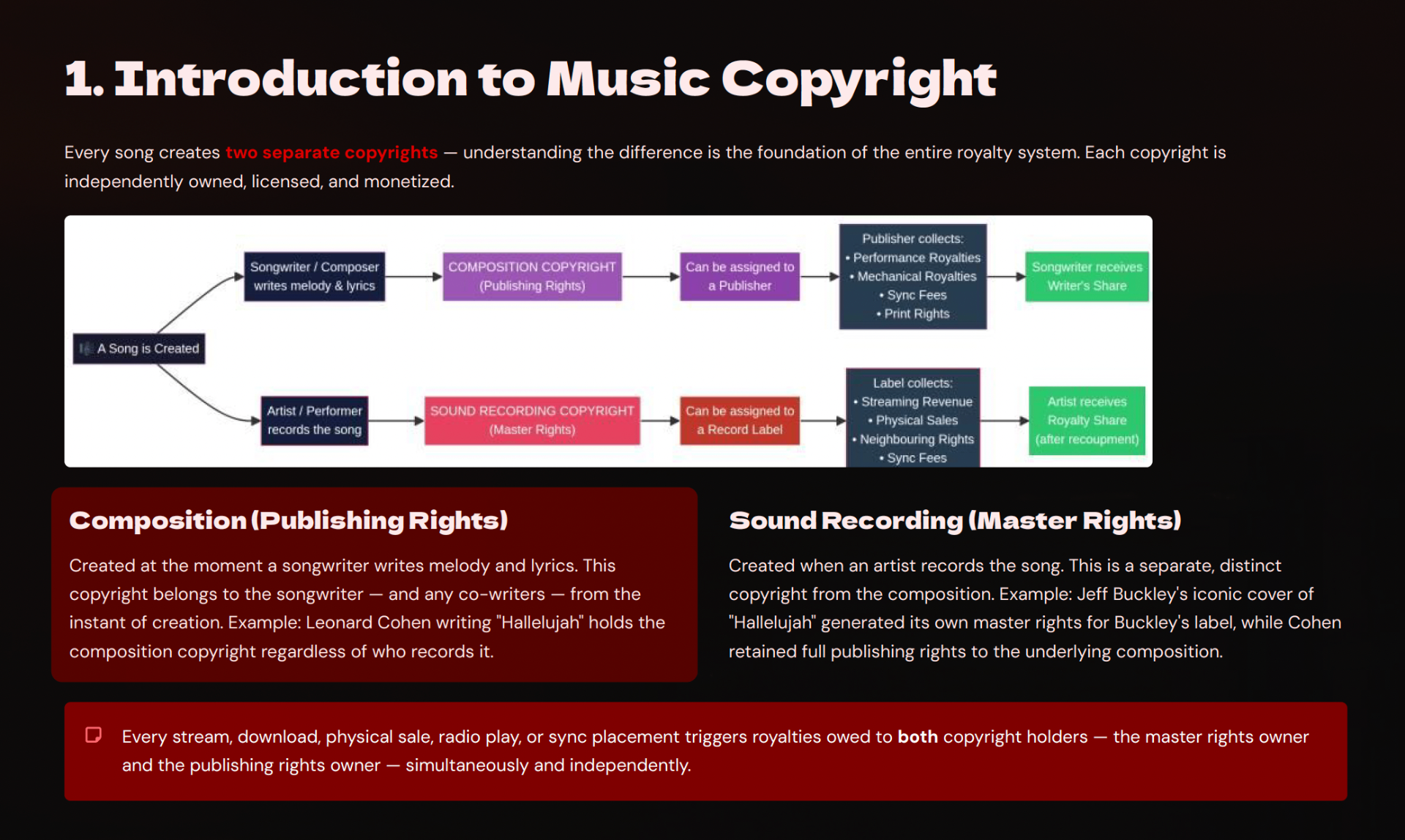
The Two Copyrights
Every song has two separate copyrights: the composition (the underlying lyrics and melody) and the sound recording (the specific recorded version). Each generates its own royalty streams, and each is collected by a different set of intermediaries.
If you wrote and recorded your own song, you own both — but you still have to register on both sides to actually get paid. Owning the right and collecting on it are two different jobs.
Performance Royalties
Generated whenever a song is played publicly — radio, streaming, live venues, restaurants, TV. The composition side is collected by PROs (ASCAP, BMI, SESAC, GMR in the US; PRS, SOCAN, APRA globally). The sound recording side, for non-interactive streams and satellite, is collected in the US by SoundExchange.
Common leak: artists sign up with a PRO but never register their works, or never join SoundExchange at all. That money sits unclaimed until it's swept back to the pool.
Mechanical Royalties
Paid when a composition is reproduced — physical, download, or interactive stream (Spotify, Apple Music, Amazon). In the US, the MLC (Mechanical Licensing Collective) handles streaming mechanicals for the composition side. Outside the US, publishers and CMOs handle it.
If you're your own publisher, you need to register with the MLC directly, plus a publishing admin (or self-admin) for global collection. Distribution alone does not cover this.
Sync Royalties
Licensing a song into film, TV, ads, games, or trailers. Two fees are negotiated separately: the sync fee (composition) and the master use fee (recording). These are one-time upfront payments, then back-end performance royalties flow every time the placement airs.
Sync is one of the highest-margin income sources in music because it pays both sides of the copyright and doesn't cannibalize streaming revenue.
Neighboring Rights
The international counterpart to SoundExchange. When your recording plays on foreign radio or in public spaces abroad, neighboring rights societies collect on your behalf — but only if you're registered with one (PPL in the UK, SoundExchange partners internationally, or a neighboring rights admin).
US artists routinely leave 5-figures on the table here because the US doesn't have terrestrial radio performance rights for recordings, so they assume the money doesn't exist. It does — just not domestically.
Where Most Artists Lose Money
The pattern is almost always the same: registered on the recording side (distributor + SoundExchange) but nothing on the publishing side. Or a PRO account with no works registered. Or no MLC. Or no neighboring rights admin. Each gap is a permanent leak.
The fix is unglamorous but high-ROI: audit every song against every collection society, register once, and treat royalty admin as a monthly discipline, not a one-time setup.
Takeaway
Royalties aren't complicated because the system is broken — they're complicated because it's built on two copyrights and a dozen collection agents. Learn the map once, register everywhere, and you stop leaving money in every corner of the industry.